Published: November 9, 2026 Last Updated 1 day ago by Esther Ejoh
African fashion has always been creative, but its increasing presence on international runways is reshaping global perceptions of the continent’s design industry.
Through traditional weaving, indigenous textiles, contemporary tailoring, and couture techniques, African designers are establishing distinct fashion identities that merit global recognition.
Central to this movement is Cameroonian fashion designer Imane Ayissi, whose work consistently challenges the notion that African fashion must conform to a single aesthetic.
At GTCO Fashion Weekend 2026 in Lagos, Ayissi once again showcased his creative vision.
On November 7, he joined a distinguished group of African and international designers for the event’s ninth edition.
Themed “Fashion Is Timeless,” the weekend united fashion designers, entrepreneurs, industry professionals and enthusiasts to celebrate creativity, culture and the business of fashion.
For Ayissi, the Lagos runway was more than a fashion presentation. It allowed him to share his blend of African heritage and Parisian haute couture with an audience that values the craftsmanship and cultural depth of his work.
Renowned for integrating African textiles, natural materials, sculptural forms and precise silhouettes into contemporary couture, he has developed a distinctive yet innovative design language.
His appearance was especially significant given his role in the international fashion industry. In 2020, Ayissi became the first sub-Saharan African designer invited to present a collection on the official Paris Haute Couture Week calendar as a guest member of the Fédération de la Haute Couture et de la Mode.
The Cameroonian couturier brought a striking collection of colour, movement, texture and African craftsmanship to the Lagos runway.
From flowing silhouettes and bold floral details to Kente fabric, raffia and dramatic fringes, the collection celebrated the depth of African textile traditions while showing how these materials can take on new forms in contemporary fashion.
There are fashion shows that give audiences beautiful clothes to admire, and then there are presentations that leave people thinking about the stories behind the garments. Imane Ayissi’s appearance at GTCO Fashion Weekend 2026 belonged to the latter.
His collection was not simply a display of colourful womenswear. It was a reminder of the creative possibilities held within African fabrics, the skill of the people who work with them and the importance of giving traditional materials a place in conversations about fashion at the highest level.
On Saturday, November 7, the designer took to the runway at the ninth edition of GTCO Fashion Weekend in Lagos. The event, held under the theme “Fashion Is Timeless,” brought together designers from Africa and other parts of the world for two days of runway presentations, masterclasses and retail experiences.
Ayissi presented on Day One, sharing the programme with Tongoro, FIA Factory, Ibrahim Fernandez, Washington Roberts and Maison Sara Chraibi. His collection closed the first day’s runway shows, giving the audience a memorable final presentation.
What made the collection particularly interesting was the way it brought together materials and design references from different parts of the continent. Kente, raffia, floral motifs, fringes and flowing silhouettes appeared in a presentation filled with movement and strong visual details.
Rather than treating African textiles as decorative additions, Ayissi placed them at the centre of his design approach. The result was a collection that spoke about heritage without being limited by it.
The presentation was more than a fitting addition to the GTCO Fashion Weekend programme. It brought attention to a designer whose career has been shaped by the determination to place African craftsmanship within the international fashion conversation on its own terms.
Ayissi has spent years exploring the possibilities of traditional fabrics, working with artisans and applying couture techniques to materials that are often overlooked in mainstream fashion. His Lagos appearance offered an opportunity for a Nigerian audience to experience that approach up close.
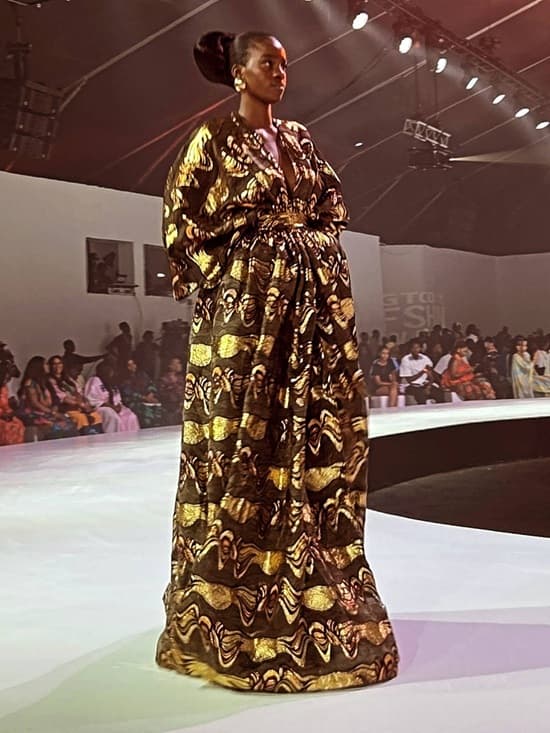 Photo: Instagram/hortenseassaga
One of the strongest features of the collection was its use of colour. The garments moved beyond the familiar neutral shades often associated with formal couture and embraced a much wider range of tones.
Rich colours, floral designs and textured surfaces gave the pieces a lively quality. There was a sense of movement throughout the presentation, with flowing silhouettes and fringed details adding character to the clothes as the models walked.
The floral elements were particularly interesting. Rather than appearing as simple prints placed on otherwise familiar garments, the three-dimensional floral details added depth and structure.
They gave certain pieces a sculptural quality, creating the impression that the designs had been built around the flowers rather than simply decorated with them.
This approach brought another layer of craftsmanship to the collection and showed how a familiar natural form could become an important part of a garment’s construction.
Fringes also played an important role. They introduced movement, texture, and a playful quality to the clothes. On the runway, these details responded to the models’ movements, making the garments look different from one moment to the next.
The effect was especially effective when paired with the collection’s flowing shapes. Instead of relying on elaborate styling alone, Ayissi allowed the construction and details of the clothes to create much of the visual interest.
Kente was another important feature of the presentation. The Ghanaian textile, recognised for its woven patterns and strong colours, has a long history of cultural significance. Its use in contemporary fashion requires an understanding of the material, its origins and the people who produce it.
Ayissi has built a significant part of his design identity around bringing textiles such as Kente into modern couture, demonstrating that traditional fabrics can be used in ways that go beyond familiar interpretations.
His approach is not to make African materials appear European. Instead, he brings them into a design language that respects their origins while allowing room for experimentation.
This distinction matters. African textiles do not need to lose their character to be considered relevant to international fashion. They can retain their cultural identity and still be part of garments with contemporary shapes, detailed construction and a clear point of view.
That idea has been central to Ayissi’s work for years. In an interview with British Vogue, the designer discussed his interest in presenting the diversity of African cultures and challenging simplified ideas about the continent.
He has also worked with materials including Ghanaian Kente, raffia from Cameroon and Madagascar, Obom bark cloth from Cameroon and bògòlanfini from Mali.
These materials have appeared in different forms across his collections, from embellishments and floral details to coats, dresses and other carefully constructed pieces.
Born in Cameroon in 1969, he was raised in a family immersed in creativity and artistic expression.
His father, Jean-Baptiste Ayissi Ntsama, was a champion boxer, and his mother, Julienne Honorine Eyenga Ayissi, was crowned Miss Cameroon in 1960. His siblings’ involvement in dance and music fostered his early appreciation for movement and the visual arts.
Before becoming a couturier, Ayissi trained with the National Ballet of Cameroon, which exposed him to diverse cultural performances and international travel. This experience later influenced his approach to fashion, especially his interest in how clothing moves with the body.
Dance requires an understanding of posture, balance, movement, and space, all of which are also essential in garment construction. While a dress may look appealing on a mannequin, its true relationship with the wearer emerges through movement.
Ayissi’s performance background informs his use of draping, volume, pleating, and flowing silhouettes.
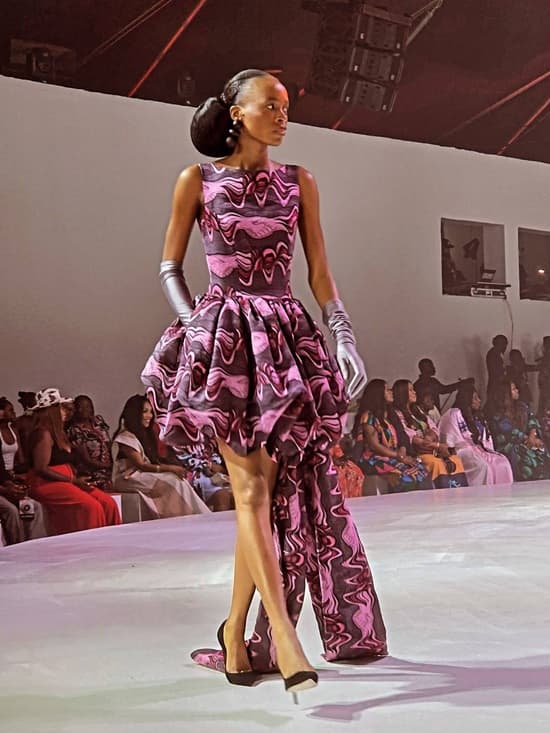 Photo: Instagram/hortenseassaga
Ayissi’s interest in fashion was also shaped by his mother.
He grew up surrounded by clothing, beauty, and the process of creating an appearance.
The Cameroonian fashion designer began making garments and later worked with a leading Cameroonian ready-to-wear atelier before pursuing an international career.
Ayissi later moved to Paris, where he entered the modeling industry and worked with renowned fashion houses such as Christian Dior, Yves Saint Laurent, Lanvin, Givenchy, Valentino and Pierre Cardin.
This experience allowed him to learn the technical standards, presentation, and creative processes that define European fashion.
However, modeling was not his final goal.
As he built industry relationships, he continued to develop his own ideas about clothing and design. He eventually focused on fashion, creating made-to-measure garments and establishing a label to pursue his artistic vision.
In 2004, he founded his eponymous fashion house, Imane Ayissi Couture.
The label became a platform for combining his African heritage, Parisian experience, and commitment to traditional craftsmanship.
His work gained international recognition for its distinctive textiles, refined silhouettes, and integration of African heritage with contemporary fashion.
His inclusion in the official Paris Haute Couture calendar in 2020 was a defining moment.
The Fédération de la Haute Couture et de la Mode recognized him as a guest member, making him the first sub-Saharan African fashion designer to receive this honour.
This milestone was significant for his career and for the broader representation of African designers within a leading fashion institution.
The significance of this achievement is evident when considering what haute couture represents.
It is not merely expensive clothing or elaborate eveningwear, but is defined by exceptional construction, skilled handwork, individual craftsmanship, and high creative and technical standards.
Joining the official calendar placed Ayissi within a fashion system renowned for its rigor.
For an African fashion designer using materials and techniques often overlooked by mainstream fashion, this recognition was especially meaningful.
It showed that African textile traditions and artisanal knowledge can thrive at the highest levels of international couture without losing their identity.
A defining feature of Ayissi’s work is his use of African textiles.
His collections include Ghanaian Kente, Burkina Faso’s Faso Dan Fani, Nigerian woven fabrics, Madagascan raffia, and Cameroonian textiles. He treats these materials as integral to garment construction, not merely as decorative references.
This distinction is important.
African textiles are often used in contemporary fashion for their prints, colours and patterns.
While valuable, Ayissi’s work focuses on the fabrics themselves, considering their weight, texture, flexibility, and how they behave when cut, folded, gathered or draped.
For example, a woven textile may differ structurally from silk or other materials common in Parisian couture.
Its thickness, finish, and natural irregularities affect garment construction. Using these materials requires understanding their properties and adapting traditional techniques to new silhouettes.
This aspect makes Ayissi’s work especially compelling.
His designs demonstrate that African textiles need not be limited to traditional clothing. They can be transformed into structured jackets, flowing gowns, sculptural dresses, tailored pieces, and contemporary eveningwear.
His approach challenges the tendency to group African fashion into a single design movement.
Africa encompasses diverse textile traditions, weaving communities, cultural histories and garment production methods. Kente, Aso Oke, Manjak cloth, raffia and Faso Dan Fani each have distinct identities and histories.
Incorporating them into couture collections requires more than choosing attractive fabrics; it demands understanding their significance and using them respectfully.
Ayissi has explained his choice to avoid wax prints due to their complex colonial history and commercial ties to African fashion.
Instead, he focuses on handwoven and indigenous textiles that connect more directly with the communities and craftsmanship he aims to highlight.
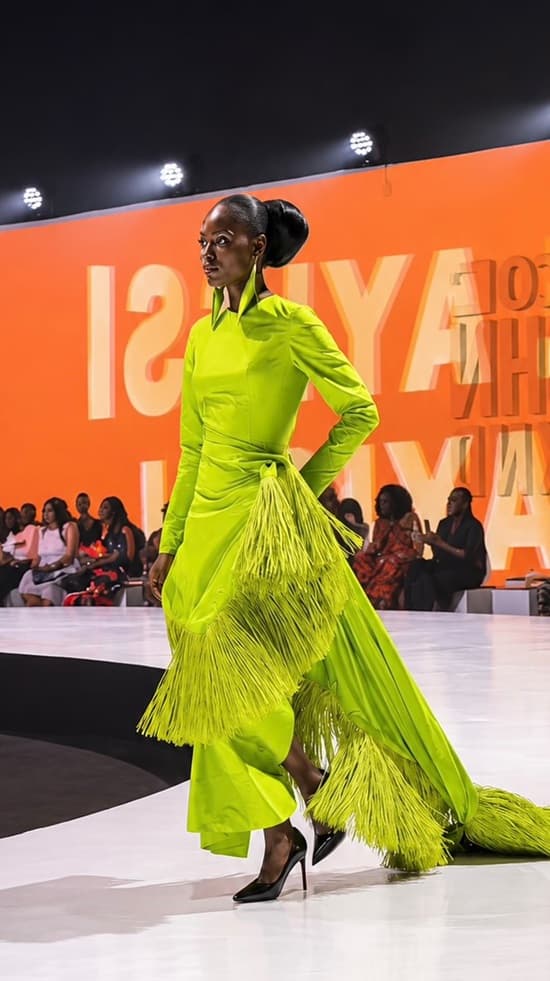 Photo: Instagram/vanessazar
His approach underscores the broader material history of African fashion beyond commonly recognized prints.
This philosophy remains central to his work, including his Spring/Summer 2026 couture collection, BISSAKARAK.
Presented in Paris on January 26, 2026, the collection explored the creative process from initial sketch to garment formation on a mannequin.
The title comes from Ewondo, Ayissi’s mother tongue, and refers to a scribble or first draft, representing the early stage of an idea.
He used this concept to examine the relationship between drawing, silhouette, volume, and fabric movement.
The concept behind BISSAKARAK is central to understanding his work.
Fashion often begins with a line, a fold, a piece of fabric or an unexpected material combination, rather than a complete vision. The designer experiments with these elements until the garment develops its own character.
Draping, pleating and tying techniques were central to the collection’s creative direction.
Ayissi explored fabric arrangement, volume development and the creation of new shapes with various materials. The collection combined African textiles with established couture fabrics such as silk faille and gazar.
These ideas provide context for his appearance at GTCO Fashion Weekend.
Although the Lagos presentation was a separate event, the principles that define his couture practice remain relevant: an interest in movement, thoughtful material use, and viewing fashion as artistic expression.
His work consistently explores the balance between structure and fluidity.
Some garments feature defined shoulders, fitted bodices and shaped waists, while others use generous volumes, layered fabrics and draping. This approach creates a wardrobe that is not limited to a single silhouette.
This contrast is important, as couture is often associated with excessive decoration.
Ayissi also shows technical skill in garment construction, fabric drape, and the interplay of design elements. A simple-looking dress may require significant work to achieve its final shape.
His runway presentations reflect his understanding of performance.
As a former dancer, he recognizes that clothing exists in motion, and the runway allows audiences to see how garments respond to the wearer.
This connection between fashion and movement distinguishes his work.
For example, a cape can transform a silhouette as the wearer walks, a pleated skirt may reveal layers when the model turns, and a structured sleeve can create volume and alter body proportions.
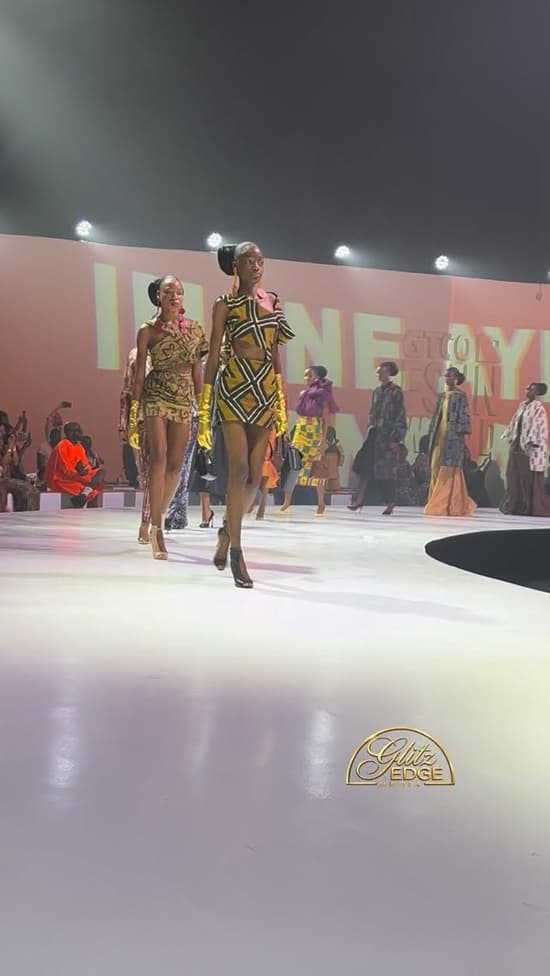 Photo: instagram/glitzedgemedia
Ayissi’s background enables him to appreciate how clothing behaves in motion.
His collections are designed not just for photography, but to be worn, experienced, and observed in movement.
His appearance at GTCO Fashion Weekend built on his earlier relationship with the platform. He participated in the 2025 edition, where his collection was noted for its use of African craftsmanship and contemporary couture construction.
His return in 2026 reinforced the event’s commitment to showcasing established international designers and diverse perspectives.
Fashion coverage described the 2025 presentation as a meeting of African textiles and global design codes.
Fabrics like Ghanaian Kente and Burkina Faso’s Faso Dan Fani appeared alongside structured jackets, sculpted gowns and tailored skirts.
The collection showed how culturally significant materials can be integrated into modern silhouettes without losing their character.
His return gave Lagos audiences another opportunity to engage with his work. Previous attendees were already familiar with his approach, while new viewers experienced his designs for the first time through the 2026 runway.
Ayissi’s participation is significant in the context of GTCO Fashion Weekend’s role in Nigeria’s fashion industry.
Since 2016, the event has evolved into a platform combining runway shows, retail opportunities, fashion education and industry discussions. It not only showcases new collections but also helps entrepreneurs connect with customers, grow their businesses and reach wider audiences.
The ninth edition, themed “Fashion Is Timeless”, continued this approach.
Held at the GTCentre in Lagos on November 7 and 8, the event featured twelve designers, 140 curated fashion retail businesses, masterclasses and a dedicated Streetwear Hub.
Free attendance made the experience accessible to enthusiasts, students, entrepreneurs and professionals.
The theme was especially relevant to Ayissi’s work.
His designs draw on longstanding traditions, yet his approach is contemporary. He views heritage not as something confined to museums, but as an ongoing source of inspiration for modern dress.
This intergenerational view of fashion matters for African designers. Traditional weaving, embroidery, dyeing, and other artisanal practices have endured through community knowledge and skilled makers.
Preserving these techniques requires integrating them into contemporary markets, where designers can generate demand for both the materials and their producers.
Ayissi’s approach demonstrates how this integration can occur.
By incorporating African textiles into international couture, he offers audiences new ways to experience these materials. His work also encourages designers to explore the technical potential of locally produced fabrics beyond traditional garments.
This conversation also has an economic dimension.
The fashion industry relies on a broad network, including textile producers, weavers, pattern cutters, tailors, embroiderers, artisans, photographers, models, stylists and retailers.
By centering collections on specialized craftsmanship, designers enhance the visibility and commercial value of these skills.
This is especially relevant in Africa, where the fashion industry has significant creative potential but faces challenges in manufacturing, material access, infrastructure, distribution, and entry into international markets.
Platforms like GTCO Fashion Weekend help address these challenges by providing spaces for designers to meet customers and connect with industry peers.
The event’s retail component is crucial, bringing the business side of fashion together with the runway.
For 2026, the organisers introduced the GTCO Fashion Collective, a year-round initiative connecting designers, models, stylists, photographers, editors, buyers, content creators and other professionals.
The platform aims to extend opportunities from the annual event through ongoing collaboration, knowledge-sharing and commercial connections.
For designers like Ayissi, this broader ecosystem is essential because fashion relies on the businesses and people that support it.
While a runway presentation can introduce a collection, building a sustainable business requires strong relationships with manufacturers, buyers, retailers, media and customers.
His career illustrates the importance of connecting different fashion markets. Although his fashion house is based in Paris, his creative identity remains closely tied to Cameroon and other parts of Africa.
His collections show that designers can participate in the international fashion system without losing the cultural experiences that shape their perspective.
This makes his role in African fashion especially noteworthy. He views his identity not as a barrier to international success, but as a core element of his creative practice.
His work has attracted attention from leading figures in entertainment and fashion, including Zendaya and Angela Bassett, who have worn his designs.
These appearances have introduced his work to broader audiences and reinforced his reputation as a designer whose creations transition seamlessly between exhibitions, red carpets and international events.
The recognition of his work has also extended into the museum world.
In 2024, SCAD FASH Museum of Fashion + Film in Atlanta presented Imane Ayissi: From Africa to the World, an exhibition dedicated to his creative practice.
Curated by Rafael Gomes, the exhibition explored the designer’s relationship with African heritage, couture craftsmanship and international fashion.
The exhibition was significant as it allowed audiences to engage with his work beyond the runway.
It examined the ideas, materials and cultural influences shaping his creations, highlighting an African designer within a major fashion museum’s programme.
Sustainability is central to his design philosophy.
Ayissi prioritises natural and organic materials, supports traditional craftsmanship and considers the environmental impact of production. His choice of textiles and artisanal methods reflects a commitment to respecting both materials and the people who produce them.
Sustainability in couture extends beyond fabric choices.
It includes garment longevity, construction quality, skilled labour and resource use. Made-to-measure fashion fosters a more thoughtful relationship with clothing by addressing individual client needs.
This discussion is especially relevant for African fashion businesses.
The continent’s rich textile knowledge and artisanal skills require investment, recognition, and market access to be preserved.
Designers who integrate these traditions into modern collections help sustain them and create opportunities for their communities.
Ayissi’s work is relevant beyond fashion.
It prompts reflection on the recognition of African creative knowledge, the role of traditional materials in international markets, and how designers can build businesses while preserving their cultural identity.
GTCO Fashion Weekend 2026 provided a fitting platform for these discussions. The event showcased diverse design perspectives, and Ayissi’s participation added a couture dimension, connecting Lagos’s audience with a designer shaped by both African and European influences.
His participation also highlighted the importance of international collaboration in African fashion.
As the industry becomes more global, designers gain opportunities to work across markets and cultures. These collaborations introduce African labels to new customers, facilitate knowledge exchange, and foster future partnerships.
Photo: Instagram/vanessazar
You May Also Like:
12 Things We Want to See From African Fashion Brands in 2027
Sarah Diouf Gave Prints a New Meaning at GTCO Fashion Weekend in Lagos
The African Girlie Starter Pack To Follow

AFRIFF at 15: Africa's Biggest Film Festival Just Doubled Down on the Future
Lagos Fashion Week Day 4: Closing the On-site Runway in Style

Lagos Fashion Week Day 3: The People and Designs Moving Fashion Forward Beyond Craftsmanship
Lagos Fashion Week Day Two: Insights, Industry, and Runway Highlights
Oshobor Reimagined Wool and Breezy Feathers into Cute Pieces at Lagos Fashion Week

Inside Kilentar's SS27 2026 Lagos Fashion Week Show
Hertunba Opens Lagos Fashion Week 2026 with Heritage and Powerful Silhouettes

Lagos Fashion Week 2026: Day 1 Conversations on the Future of African Fashion
LFJ’s Jupiter Collection Takes Lagos Fashion Week into Orbit


Esther Ejoh is a Fashion Editor at Fashion Police Nigeria, where she writes all things fashion, beauty, and celebrity style, with a sharp eye and an even sharper pen. She’s the girl who’ll break down a Met Gala look one minute, rave about a Nigerian beauty brand the next, and still find time to binge a movie or get lost in a novel. Style, storytelling, and self-care? That’s her holy trinity.