Published: May 12, 2026 Last Updated 5 months ago by Esther Ejoh
The 2026 Africa Magic Viewers’ Choice Awards featured many notable fashion moments, with the most discussed being the architectural cathedral gown worn by Ghanaian style icon Nana Akua Addo.
Designed by Nigerian couturier Mohammed Abbas Ossu of Abbas Woman, the grey-toned gown was inspired by the Cologne Cathedral in Germany and incorporated elements such as spires, Gothic arches, doors, windows, pillars, and a cross.
The dress made a significant impact, drawing widespread praise on social media. Adunni Ade stated, “You didn’t wear couture, you became the cathedral.” Mary Remmy Njoku wrote, “Aaaahh! I am not going again. Whaaaaa!!!” Chioma Ikokwu added, “And no one competes for the crown with you in this house!”
However, days after this red carpet success, a dispute arose. Paris-based fashion house ALmée Couture accused the gown’s creators of copying its concept. This led to a public debate among international designers and fashion enthusiasts, raising questions about the boundaries between inspiration and intellectual property.
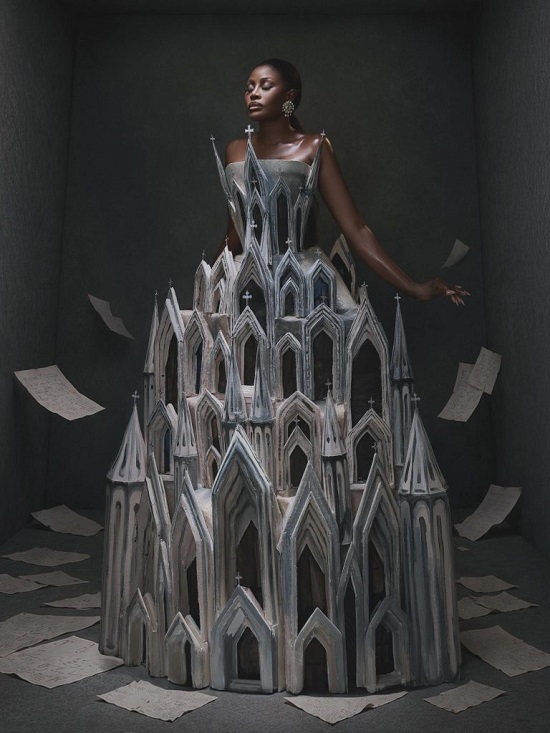 Photo: Instgaram/nanaakuaaddo
 On May 11, 2026, ALmée Couture posted an image of the original sketch on Instagram, accusing the Nigerian designer, widely understood to be Mohammed Abbas Ossu, of “blatant THEFT.” The caption read, “This project was originally developed with the client last year as part of a commissioned couture piece. The client initially shared a cathedral-inspired concept with us, which served only as the starting point of the discussion. From there, ALmée Couture was fully responsible for developing the final artistic vision, original sketch, silhouette, structural detailing, couture direction, and overall execution of the design.”
In a detailed statement, ALmée explained that the project began as a commissioned couture piece for Nana Akua Addo, with the client providing a cathedral-inspired concept as a starting point. ALmée stated they were responsible for developing the final artistic vision, sketches, silhouette, structural details, and overall execution.
 Photo: Instagram/almee.lii
 After the project was canceled and the deposit refunded, ALmée claimed it was “clearly communicated and mutually acknowledged” that they would retain full ownership and exclusive rights to the design and sketches. They later alleged the final gown was “produced elsewhere using the original sketch and developed design direction created by ALmée Couture, without acknowledgment of our creative contribution.”
ALmée clarified they “never claimed ownership over the cathedral concept itself.” Their concern is that the transformation of a general idea into a couture design is the designer’s work, and that work was used without credit.
Nana Akua Addo responded promptly on May 11, 2026, rejecting ALmée’s allegations and asserting that the creative direction and original idea were hers. She wrote on Instagram, “I reached out to Almeer for my outfit. I shared my idea with you and explained exactly how I wanted it. You mentioned that you didn’t want to execute it the way I envisioned because of how detailed my ideas were.
A refund was made, and I eventually got someone else to create it.” She continued, “So why and how is it now being claimed as yours?… THE AUDACITY!!!!! THIS WAS MY MOODBOARD, architecture, structure!!!!” Nana also shared private conversations to support her claim as the originator of the cathedral concept. Her position is that she provided a complete idea to ALmée, who declined to execute it as she envisioned, prompting her to seek another designer.
She acknowledges that the final gown resembles ALmée’s sketches, but attributes this to both designs being based on her mood board and references. Nana maintains that ALmée’s sketches were a visual translation of her ideas, which she was entitled to use elsewhere when ALmée declined the project.
 Photo: Instagram/nanaakuaaddo
 The controversy quickly spread to Instagram, where supporters of Nana and Abbas Woman argued that a client’s vision belongs to the client. One commenter wrote, “If you have a case, please go to court. This is just clout chasing. She brought her idea to you and you couldn’t deliver. She went elsewhere with her idea. End of discussion!”
Another added, “She showed you her design, you stole it and executed it behind her back and still have the audacity to tag @abbaswoman.ng a thief?” A third commenter defended the Nigerian designer, stating, “Poster can you keep @abbaswoman.ng and @nanaakuaaddo out of your mouth and sight. If the business didn’t work out with you but it happened with a Nigerian designer, just give credit to this designer and stop giving him headache.”
Others supported ALmée, contending that even if the idea originated with the client, the specific interpretation, structural details, and execution are the intellectual property of the designer. One user summarized the debate: “All this long epistle ontop person idea that she brought to you?! You published her idea out with no credit and now claiming what?” The core issue remains: if a client provides a reference and a designer creates a sketch, who owns the resulting design—the client or the designer?
Mohammed Abbas Ossu of Abbas Woman, the Nigerian designer at the center of the controversy, has remained largely silent publicly. Abbas had previously described the cathedral gown as his own creation, inspired by the Cologne Cathedral, and discussed the technical challenges involved, such as hand-painting the cross and incorporating lights. Abbas has not responded to ALmée’s accusations.
His supporters argue that he simply executed Nana’s vision and view ALmée’s claims as an attempt to undermine Nigerian talent. The controversy raises questions for Abbas, as he is now linked to a gown that closely resembles ALmée’s sketches, though it is unclear whether he was aware of ALmée’s prior involvement.
This dispute arises as the African fashion industry experiences rapid growth and increased international recognition. With this expansion comes a greater need for clear rules regarding intellectual property, client-designer agreements, and the management of creative concepts. Many African fashion houses still rely on informal agreements, where a client shares an idea, a designer produces sketches, and work begins after a deposit.
When such relationships end, ownership of the resulting work can become contentious. The Nana Akua Addo case underscores the importance of written contracts that define ownership of sketches, mood boards, and designs before production begins.
ALmée asserts that ownership of the developed design was “clearly communicated and mutually acknowledged,” while Nana maintains she originated the idea and took it elsewhere when ALmée declined to execute it as she wished. Without a signed contract, a resolution may remain elusive.
The controversy also highlights broader issues of collaboration and credit across borders, as the parties involved are based in Ghana, Paris, and Nigeria, while the gown was produced in Lagos. The global nature of fashion is advancing faster than the laws and ethical standards that govern it.
Both parties agree that the cathedral concept itself is not proprietary. The Cologne Cathedral is a public landmark and a source of inspiration for many artists. ALmée has stated they “never claimed ownership over the cathedral concept itself.” The dispute centers on the specific translation of the cathedral into a dress.
ALmée asserts that their architectural interpretation, including proportions, spire placement, structural details, and fabric techniques, is original. Nana contends that these details were based on her mood board and instructions.
Without access to both the original ALmée sketches and the final Abbas Woman gown, and without knowing the extent of Nana’s direction, it is difficult for outsiders to assess. The two designs are clearly similar, but whether this constitutes “blatant theft” or simply two designers interpreting the same brief may ultimately be decided by a court.
Currently, neither Nana Akua Addo nor Mohammed Abbas Ossu has indicated plans to pursue legal action, and ALmée has not announced any proceedings. The dispute remains a public relations issue on Instagram.
Despite this, the controversy has prompted important discussions about intellectual property protection in African fashion and the risks of informal agreements. It also highlights the extensive work and negotiation involved in creating high-profile designs. For Nana Akua Addo, the cathedral gown is a celebrated achievement. For Abbas Woman, it marks a career milestone.
For ALmée Couture, it serves as a reminder of the importance of signed contracts and the risks associated with sharing digital sketches.
In the end, the cathedral gown that so amazed the world at the AMVCA 2026 now carries a more complex legacy. It is not only a work of art but also a focal point in the ongoing debate over ownership and credit in fashion. Artistic inspiration often builds on existing sources, as seen with the Cologne Cathedral itself. The key issue is whether specific, original expressions of inspiration can be owned and protected.
As African fashion grows, these questions will become increasingly important. Designers must safeguard their sketches, clients must protect their ideas, and formal contracts will become essential as informal agreements fade.
Photo: Instagram/nanaakuaaddo
You May Also Like:
Kylie Jenner Makes Her Victoria’s Secret Fashion Show Debut in $50 Million Fantasy Bra
October 19, 2026Gbemi Olateru-Olagbegi Returns with Season 2 of 'The Fashion Roundtable'
October 9, 2026Rihanna is Officially the Face of J'adore Intense
August 12, 2026Ruka Hair Has Joined Sephora as the First Black-Owned Braiding Brand
July 30, 2026Zendaya is the New Face of Prada Paradoxe
July 30, 2026Hailey Bieber’s New Gap Jeans Are the Ultimate Summer Staple
July 21, 2026Olivier Rousteing is the New Creative Director of Paco Rabanne
July 14, 2026Nana Akua Addo Appears to Respond to Yvonne Nelson Over Her Red Carpet Look
June 11, 2026Olandria X Brandon Blackwood Announce Doll-Like Handbag Collaboration
May 25, 2026Chanel on Fire for Sending its Ambassador Bhavita Mandava to the Met Gala in a Slouchy Top and Jeans
May 6, 2026Simone Ashley Stuns in Skimpy Bikinis for Burberry x Hunza G Swimwear Collection 2026
April 28, 2026Zendaya and Law Roach Debut Their First Co-Created Collection with "ON"
April 9, 2026


Esther Ejoh is a Fashion Editor at Fashion Police Nigeria, where she writes all things fashion, beauty, and celebrity style, with a sharp eye and an even sharper pen. She’s the girl who’ll break down a Met Gala look one minute, rave about a Nigerian beauty brand the next, and still find time to binge a movie or get lost in a novel. Style, storytelling, and self-care? That’s her holy trinity.