Published: April 29, 2026 Last Updated 6 months ago by Faustina Marfo
Applying minimal makeup exposed how much the skin itself determines the final result.
One evening, I paid closer attention to how my foundation-and-powder combination looked throughout the day. The finish that looked acceptable in the morning had changed. Foundation settled around dry areas, while powder remained visible on the surface instead of settling into the skin. The skin underneath carried an uneven balance that the products could not smooth out.
Even with a light application, the ‘makeup’ still carried more responsibility than it could handle. I depended on a thin layer of coverage to create the appearance of even tone, but that effect became harder to maintain as the day progressed. Small adjustments stopped working, and the surface began to break through the coverage.
That moment changed the direction of my attention. Instead of focusing on how much product was needed to correct the skin, I started reading how the skin behaved on its own. Surface consistency became the first point of evaluation, not the finish created on top of it.
I Was Focused on Coverage, Not Healthy Skin
My approach to beauty used to begin with correction.
On melanin-rich skin, hyperpigmentation persists, often turning foundation into a daily obligation rather than a choice. I relied on a light layer of product to blur these marks, but the finish rarely held its integrity. Makeup created a brief appearance of balance without addressing the underlying inconsistency of the surface.
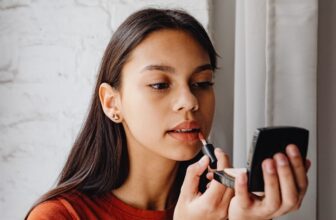
My beauty routine was minimal, involving foundation, powder, and lip gloss. Even with a few products, the result looked even only at a glance. Up close, the lack of healthy skin showed through.
Foundation settled into uneven surface areas, clinging to dry patches and sliding off oilier zones. Powder, intended to set the look, often sat visibly on the skin rather than blending in.
 Photo: Instagram/@lenatimera
 The process demanded constant maintenance despite its simplicity. Midday adjustments became necessary because the foundation would break down around the nose or chin. Reapplying powder only added weight to an already unbalanced surface, creating a finish that looked heavy rather than clean. Each step was intended to fix a problem the skin could not resolve on its own.
At that stage, coverage carried the entire result. Because the surface lacked stability, the foundation and powder worked against the skin rather than with it. The finish depended entirely on how much product was applied, which made getting ready feel like a cycle of temporary fixes.
Learning My Skin Changed My Routine Completely
The shift began when I stopped guessing and started learning my skin. Product reactions became easier to trace. Some harsh face cleansers disrupted the skin’s moisture balance, leaving the skin feeling tight by midday. Certain formulations sat without absorption, while others triggered congestion within days.
The issue was not excess use, but misalignment between the product’s function and my skin.
A single mistake made that clearer. I used a cleanser designed for dry skin because it worked for my friends with visibly glowing results. My combination skin responded differently. Within days, congestion formed across the T-zone, and surface unevenness made even light makeup sit poorly. That reaction dispelled the assumption that a single routine could work across different skin types without adjustment.
 Photo: Instagram/@eugeniakelcy
 The resulting regimen functioned as a controlled system. A gentle cleanser preserved the moisture barrier; targeted treatments addressed specific congestion. Sunscreen became a non-negotiable requirement for maintaining surface integrity. Each step served a defined purpose, and uncoordinated layering was removed entirely from the process.
What followed was consistency built on observation. My skin responded gradually, but more predictably. Instead of reacting to issues as they appeared, the routine began to prevent them through structure and restraint.
Healthy Skin Simplified Everything Else
The difference showed up in how little intervention the skin required. The foundation no longer masks surface irregularities. Concealer shifted from a daily necessity to an occasional tool. The reduction was not about skipping steps, but about removing the need for constant correction.
With a more balanced surface, products sat differently. Makeup adhered more securely, settling without patchiness or excess buildup. There was no midday disruption, no powder reapplication to manage breakdown, and no need to rebuild coverage as the day progressed.
 Photo: Instagram/@melviee
 The regimen itself also became lighter in structure. A cleanser, toner, serum, moisturiser, and sunscreen carried most of the work without additional layering. Each step supported surface integrity rather than compensating for imbalance.
Even small treatments stayed functional. A honey mask, used periodically, supported refinement of the skin’s surface without disrupting the overall system. Nothing sat outside the structure anymore. Every product had a defined role, and nothing worked against the rest.
Beauty Feels Different When Skin Comes First
The shift shows up in how I approach getting ready. My skin no longer depends on constant correction to look its best. It holds its own balance, and that stability changes every decision that follows.
 Photo Courtesy
 Healthy skin does not remove variation, but it changes how variation is handled. Breakouts, texture changes, or uneven tone no longer trigger immediate coverage. The response now sits in adjustment rather than concealment. The regimen carries the responsibility of maintaining that stability.
This change also sharpens how products are assessed. Formulation, compatibility, and long-term effect matter more than immediate finish. The skin responds better when each product fits into a defined structure rather than operating in isolation.
Getting ready no longer requires guesswork or correction. The skin maintains its own equilibrium. My approach has shifted from cosmetic intervention to maintenance; precision has finally replaced the need for coverage.
Photo Courtesy
You May Also Like:
The Regenerative and Natural Face Trends Taking Over in 2026
October 11, 202610 Reasons Why Your Lips Also Need SPF Protection
September 9, 2026Suede Eyeshadow Could Be Your Fall Favourite Eye Makeup
September 3, 2026Huda Beauty x Cardi B Team Up for the New Ultra Snatched Collection
August 31, 2026How to Achieve Glowing Skin Naturally in Africa's Climate
August 28, 202610 Best Pimple Patches for Faster, Less Noticeable Breakouts
August 21, 20267 Best Face Masks for Plump, Hydrated, Smooth Skin
August 20, 2026How to Build the Perfect Skincare Routine for African Skin
August 18, 2026Your Ultimate Guide for the Best Skincare Products for Dark Skin in Nigeria and Ghana
August 13, 2026How Does Healthy Skin Look? Here's How to Tell the Difference
July 29, 2026Refillable Lipsticks are the Beauty Investment Worth Making
July 24, 2026The Makeup Trends I'm Happily Leaving Behind This Summer
July 22, 2026


Evelyn Adenike is an Associate Beauty Editor at Fashion Police Nigeria, where she covers all things beauty, from the glossiest nail trends to the best skincare finds. With a soft spot for storytelling and an eye for what’s fresh, she brings creativity and just the right dash of drama to every post. If it’s bold, beautiful, and blog-worthy, Evelyn’s probably already writing about it.