Published: May 27, 2026 Last Updated 5 months ago by FPN
To the untrained eye, a piece of Akwete cloth might look like a beautifully patterned textile.
To the Igbo people of southeastern Nigeria, however, that same cloth is a novel, a historical document, a spiritual talisman, and a status symbol all woven into one. The intricate motifs are not merely decorative; they are visual sentences telling stories of royalty, warfare, motherhood, and divinity.
Long before written records were common in this part of Nigeria, the Igbo had already developed a sophisticated system of non-verbal communication through their weaving. Specific patterns were reserved for kings, others were believed to protect warriors heading into battle, and some were so sacred that wearing them without the proper title could once have resulted in severe punishment. This is the power of Igbo traditional textiles. They are not just fabrics; they are a language woven in thread.
The Igbo people, one of the largest ethnic groups in Nigeria, have a rich textile heritage that spans centuries. From the prestigious hand-woven Akwete to the sacred white Akwa Ocha, from the regal Isiagu to the luxurious George wrapper, each fabric tells a unique story about the wearer’s status, occasion, and cultural identity.
In this comprehensive guide, keep reading as we unravel the threads of the most significant Igbo traditional fabrics and explore the hidden meanings behind their motifs, the rituals surrounding their creation, and how these ancient textiles are being reimagined for the modern wardrobe.
Akwete: The Masterpiece of Motifs
When discussing Igbo traditional fabrics, one name rises above all others: Akwete. Originating from the town of Akwete (also known as Ndoki) in Abia State, this hand-woven textile is so iconic that it has become synonymous with Igbo weaving excellence. Historically known as “Akwa Miri,” meaning “Cloth of the Water,” Akwete weaving is said to be as old as the Igbo nation itself.
What makes Akwete truly remarkable is that it is traditionally woven exclusively by women on vertical looms, a craft considered a divine gift rather than just a skill.
Unlike the narrow-strip weaving common in other parts of Nigeria, Akwete is produced on some of the largest looms in the country, allowing for the creation of complex, wide panels. The process is painstakingly slow; it can take a weaver up to three days to finish a single cloth, depending on the complexity of the pattern.
The Secret Language of Akwete Motifs
The true genius of Akwete lies in its motifs. Weavers claim to know over a hundred different patterns, though typically only three or four appear on a single piece. Each motif tells a specific story or conveys a particular value.
The Ikaki (Tortoise) motif is the most prestigious and commonly produced. Derived from the Ijebu Yoruba “Aso Olona” cloth, the tortoise was reimagined by the Igbo and became the official royal attire.
The tortoise is viewed as a wise, cunning, and resilient creature. Traditionally, wearing Ikaki was strictly reserved for royalty; anyone outside the royal family caught wearing it could be sold into slavery. The motif represents peace, wisdom, and the enduring nature of chieftaincy.
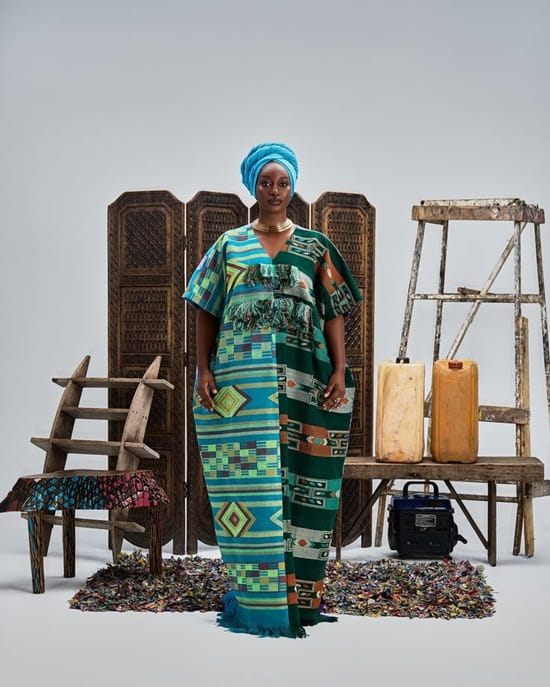 Photo: Instgaram/hertunba
 The Ebe (Drinking Cup) motifs might look simple, but they carry heavy spiritual weight. These symbols are believed to serve as talismans to protect warriors going into battle and women during pregnancy.
They represent spiritual shielding and divine protection. The Nnadede pattern is tied to a specific legend from the 1860s about a famous warrior whose father presented him with this cloth upon his triumphant return to Akwete. Initially reserved for status and royal ceremonies, it gradually became a more common yet still highly respected design.
The tradition is not frozen in time. When Christianity arrived, weavers created the “Ikperendioma” pattern, which means “the good people’s knees,” depicting kneeling Christians worshipping in a church-like setting.
Today, weavers also incorporate the Nigerian flag, the coat of arms, and other national symbols, proving that Akwete continues to evolve while maintaining its cultural soul.
Akwa Ocha: The Sacred White Cloth
If Akwete represents the vibrant celebration of Igbo culture, Akwa Ocha represents its spiritual soul. The name literally translates from Igbo to “White Cloth.”
In a world of bold patterns, this fabric stands out for its minimalism, appearing as mostly plain white cotton, often handwoven on vertical looms.
Akwa Ocha is deeply associated with purity, dignity, and spirituality. It holds a sacred place in the Odinani traditional religion. You will rarely see this fabric at a casual party; it is reserved for the most significant ceremonial festivities. It is the cloth of choice for rituals involving the deities and ancestors.
 Photo Courtesy
 For those taking the prestigious Ozo title, Akwa Ocha is mandatory attire, signifying the purity and moral uprightness required of the new titleholder. It is also worn during traditional marriage rites and is significant in funeral rites, representing the journey of the spirit.
Akwa Ocha is particularly popular among the Anioma people of Delta State and communities in Anambra State.
While it is traditionally plain, modern versions may feature subtle decorative motifs that signify the wearer’s specific lineage or status, proving that even in its quietness, the cloth speaks volumes about the wearer’s connection to tradition.
Isiagu: The Lion’s Head of Royalty
The next pillar of Igbo traditional fabrics is Isiagu, a name that translates directly to “Head of a Lion.” In Igbo culture, the leopard is a powerful and revered animal, symbolizing strength, bravery, and authority. To wear the Isiagu is to metaphorically don the skin of the lion.
Initially reserved exclusively for titled chiefs and royalty, Isiagu has become the unofficial uniform of the Igbo elite.
Traditionally, it features a unique embossment of a lion’s head (or spots) scattered across a dark base (often black, maroon, or deep blue). It is usually made of heavy cotton or velvet and worn over a matching pair of trousers, often accessorized with a red cap (Okpu Agu) and an ivory bracelet (Odu).
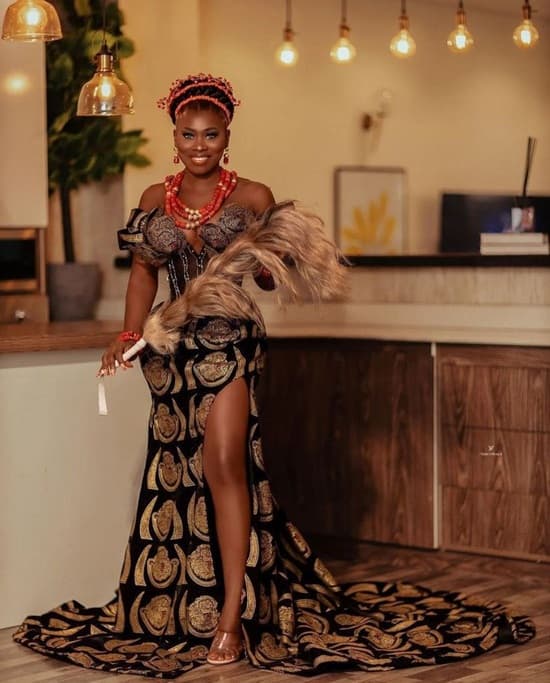 Photo Courtesy
 This Igbo traditional fabric rose to prominence as a symbol of identity after the Nigerian Civil War (Biafran War). Feeling demoralized, the Igbo community clung to the Isiagu as a way to reclaim their sense of purpose, pride, and nationality.
While traditionally male-dominated, modern fashion has seen women adopting the Isiagu print for gowns and skirts, allowing them to share in that cultural pride.
George Wrapper: The Bride’s Luxury
The George wrapper is a luxurious, heavy, intricately patterned fabric that holds a special place in Igbo weddings and high-society events.
Originally imported from Europe (specifically Manchester, England) during the colonial era, the George wrapper was quickly adopted by the Igbo elite as a symbol of wealth, status, and sophistication.
Unlike hand-woven fabrics, the George wrapper is typically machine-made, but its value comes from its weight, its intricate jacquard patterns, and the sheer yardage required for a proper wrapper.
A full George wrapper set consists of two pieces: one wrapped around the waist and a second piece worn as a shawl or headtie. The fabric is often paired with heavy coral beads (Njiji) and other precious jewelry.
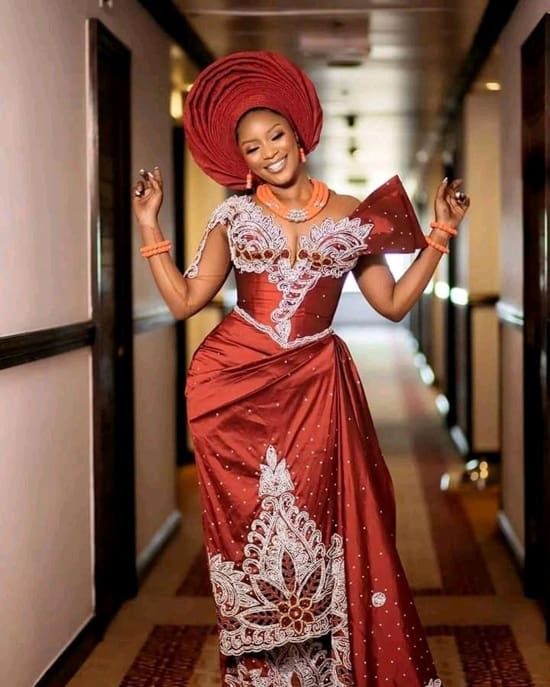 Photo Courtesy
 In Igbo traditional weddings, the bride’s mother and grandmother typically wear George wrappers as a sign of their status and the family’s wealth. The fabric is also worn by titled women and female chiefs during important ceremonies.
Common motifs on George wrappers include floral patterns, geometric designs, and sometimes even portraits of British royalty, a colonial remnant that has been fully indigenized.
Today, there are also locally produced versions of the George wrapper, but the imported ones remain the most coveted.
Udu Cloth: The Mud-Dyed Masterpiece
Udu cloth, also known as “Akwa Udu” (literally “Clay Cloth”), is a unique Igbo traditional fabric that is dyed using natural clay or mud. The fabric is typically made from hand-woven cotton that is then treated with a dye made from tannin-rich leaves and then covered with mud from specific riverbeds.
The chemical reaction between the tannins and the iron-rich mud creates a deep, rich, blackish-brown colour that is both beautiful and incredibly durable.
The fabric is then often stamped or painted with patterns using cassava paste or other resists before the dyeing process, creating intricate white or light-coloured designs against the dark background.
 Photo Courtesy
 Udu cloth is associated with the Igbo communities of the Niger Delta region, particularly in Rivers and Bayelsa States, where the clay needed for the dyeing process is readily available.
The fabric was traditionally worn by warriors, hunters, and spiritual leaders, and the dark colour was believed to have protective properties.
Today, Udu cloth is relatively rare and highly valued by collectors and fashion enthusiasts who appreciate its unique, earthy aesthetic and its deep connection to the natural environment.
The Modern Revival: Styling Tradition Today
While these Igbo traditional fabrics are ancient, they are by no means extinct. There is currently a massive renaissance happening in African fashion, with designers and style icons embracing heritage textiles.
Akwete is no longer just a wrapper; modern fashion designers are crafting Akwete into tailored blazers, structured gowns, and chic handbags. The vibrant, textured nature of the cloth makes it a favourite for aso ebi bridal parties for high-end traditional weddings.
Fashionistas are styling Akwa Ocha in avant-garde ways for church services, naming ceremonies, and even as a high-fashion statement at cultural events, proving that white is never boring when the texture and drape are perfect. Beyond the chiefs, the Isiagu print has exploded onto the streetwear scene.
Young men pair Isiagu jackets with jeans and sneakers, and women rock Isiagu dresses to parties, blending the symbol of royalty with contemporary swagger.
George wrappers are being reimagined as sculptural gowns and cocktail dresses, while Udu cloth is finding its way into high-fashion collections, worn by models on runways in Lagos, London, and New York.
The revival is not just about aesthetics; it is about economic empowerment, cultural preservation, and the reclamation of African identity.
Conclusion
The next time you see a flash of Akwete’s geometric patterns, the stark purity of Akwa Ocha, the bold spots of Isiagu, the luxurious weight of George wrapper, the bold stripes of Ntueke, the earthy depth of Udu cloth, the flowing fringes of Ebubu, the spiritual power of Ajị, or the accessible vibrancy of Akwa Ahịa, remember that you are not just looking at fabric.
You are looking at a history book written in thread, a spiritual shield, a declaration of royalty, a bride’s dowry, a dancer’s costume, and a testament to the skill of the weavers, dyers, and designers who have kept these traditions alive for centuries. These textiles are not just the clothing of the Igbo people; they are their identity.
Whether preserving ancient motifs or pushing the boundaries of contemporary style, these fabrics remain a powerful force in the world of fashion, proving that true style is indeed timeless. The threads that connect the past to the present continue to be woven, and the story of Igbo textiles is far from over.
Photo Courtesy
You May Also Like:
7 Fashion Trends to Watch at the 2026 Lagos Fashion Week
October 13, 2026Lagos Fashion Week 2026: What to Wear, Know and Expect
October 12, 20267 Emerging Fashion Designers We Would Love to See at Lagos Fashion Week 2026
October 8, 20269 Reasons You Should Attend (or Watch) Lagos Fashion Week 2026
October 7, 2026Maxhosa Africa: The First South African Fashion Brand Showcasing at Paris Fashion Week
October 2, 2026Method Dressing Among Nigerian Celebrities: Are We Finally Getting It Right?
September 8, 2026Camcassid: The Sustainable Fashion Brand Turning Textile Waste into Wearable Art
September 2, 2026The 2026 Africa Fashion Week London was a Defining Moment for African Fashion
August 24, 2026What Does Luxury Fashion Mean to an African?
August 20, 2026African Fashion Weeks 2026: Biggest Trends and Highlights
August 20, 202610 Top Affordable Luxury Fashion Brands in Africa
August 17, 2026How to Style Ankara Dresses for Every Occasion
August 11, 2026


Esther Ejoh is a Fashion Editor at Fashion Police Nigeria, where she writes all things fashion, beauty, and celebrity style, with a sharp eye and an even sharper pen. She’s the girl who’ll break down a Met Gala look one minute, rave about a Nigerian beauty brand the next, and still find time to binge a movie or get lost in a novel. Style, storytelling, and self-care? That’s her holy trinity.