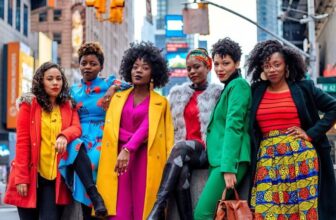
Fashion is a multi-billion-dollar industry that influences our daily lives in more ways than we realize. From the clothes we wear to the trends we follow, fashion is undeniably complicated.
You finally find a pair of skinny jeans that feel like they were made for you. You discover your perfect shade of lipstick. You master the art of tying a scarf in that one specific way that looks stylish. You feel like you’ve cracked the fashion code. Then, you open your phone.
A style influencer is calmly explaining that your beloved skinny jeans are now a “fashion faux pas,” that the scarf tie is “trying too hard,” and that the new, truly chic way to carry a handbag is to dangle it from the crook of your elbow, or maybe even to tuck it under your arm like a newspaper, definitely not to hold it by the handles. A wave of confusion washes over you. When did this happen? Why is fashion so complicated? Why does it even matter? And how are you supposed to keep up?
This is the modern fashion experience: a thrilling yet exhausting game where the rules are not only constantly rewritten but are often contradictory and seemingly designed to make you feel like you’re always one step behind. Fashion, in its purest form, is a celebration of self-expression.
So why does it so often feel like a complicated language you never quite learned to speak? The answer is a tangled web of psychology, economics, and our digital-age culture. It’s not just about clothes; it’s about our deep-seated need to belong, the relentless engine of consumerism, and the dizzying speed at which trends now live and die.
At its heart, fashion changes because we, as a society, are always changing. Our clothing is a visual diary of our collective mood. In times of economic boom, fashion might become bold, extravagant, and optimistic. In times of uncertainty or stress, we often see a return to comfort: loose, soft fabrics, nostalgic styles, and neutral colours that feel like a sartorial security blanket. But this isn’t a gentle, predictable tide. It’s more like a whirlpool.
The moment a style becomes mainstream, the fashion world, in its quest for novelty, begins to dismantle it. Fashion designers and trendsetters dive into the archives, pull out a style from two decades ago, give it a new name, and present it as the next revolution.
This is why the low-rise jeans of the early 2000s can vanish, only to reappear twenty years later to the simultaneous delight and horror of a new generation. This cycle, where the old becomes new again, creates a perpetual sense of déjà vu and whiplash, making it feel impossible to settle on a lasting personal style.
 Photo Courtesy
 The reason why fashion is so complicated comes from the fact that clothing is never just fabric. It’s a complex signal. The same exact outfit can communicate wildly different messages based on tiny details: how a collar is popped, whether a sleeve is rolled up, or how a shoe is laced. This transforms getting dressed from a simple act into a form of non-verbal communication.
The confusion intensifies when we try to replicate the confidence we see in others rather than understanding the style itself. We see a model looking incredibly cool wearing mismatched prints and think, “I need to do that.” But when we try it, it feels awkward and wrong.
The missing ingredient isn’t the specific plaid-and-floral combination; it’s the innate self-assurance of the person wearing it. We end up copying the signal without having the same source, which almost always leads to fashion frustration.
Then there are the “rules.” Fashion is infamous for its arbitrary, often nonsensical commandments. Never wear white after Labor Day. Don’t mix gold and silver jewelry. Always match your belt to your shoes. And now, in the modern era, we have a new set of micro-commandments: only tuck in the front of your shirt, wear your jacket draped over your shoulders like a cape, and yes, wear a dress over your favourite pair of pants.
 Photo: Instagram/yewande_biala
 When written out, these rules can seem ridiculous. But their power doesn’t come from logic; it comes from social signaling. Following these subtle, insider codes is a way of quietly announcing, “I am current. I am in the know.” It’s a way to differentiate oneself from the crowd without saying a word. This creates a constant, low-level anxiety that we might be breaking an invisible rule and, in doing so, revealing that we are on the outside looking in.
If the fashion cycle was once a seasonal change, social media has turned it into a relentless tsunami of micro-trends. Platforms like TikTok and Instagram have demolished the traditional calendar. Now, a fashion trend isn’t born on a Parisian runway; it’s born in a 15-second video where someone styles a sock in a bizarre new way. This fashion trend can achieve global saturation in a matter of days, no, minutes.
Fast-fashion brands, with their incredibly agile supply chains, can produce and ship a cheap version of that trend within weeks. And then, just as you’re considering buying that sock-scarf, the trend is declared “dead” by the very same digital ecosystem that created it. This accelerated pace is what makes fashion feel truly complicated. It’s a race with no finish line, where the track itself is being redrawn every few meters.
 Photo Courtesy
 Underpinning all of this chaos is a simple, powerful engine: money. The fashion industry is a multi-trillion-dollar business, and its survival depends on one thing: convincing you that what you have is no longer enough.
This is achieved by deliberately manufacturing dissatisfaction. A new shade of beige is not just a new shade of beige; it’s “greige,” and it’s revolutionary. A slightly wider leg on a pair of pants is not a minor alteration; it’s a paradigm shift in silhouette.
Through sophisticated marketing, influencer partnerships, and media, the industry creates a problem; the problem of being out-of-style, and then conveniently sells you the solution. This constant pressure to stay relevant, to avoid the social faux pas of being “dated,” keeps consumers in a perpetual state of wanting, buying, and then almost immediately wanting again.
This complexity is amplified by the fact that there is no universal agreement on what is “in” or “out.” Fashion is inherently subjective, much like art or music. One person’s edgy, fashion-forward cropped blazer is another person’s impractical, too-short jacket. The tiny sunglasses hailed as minimalist and chic by some are deemed uncomfortable and silly by others.
 Photo Courtesy
 The confusion sets in when we look for external validation for our personal taste. We give a committee of strangers on the internet the power to veto what we love. We forget that fashion, at its best, is about personal expression, not universal permission. The constant noise of conflicting opinions: “This is in!” “No, that’s out!” creates a paralyzing indecision.
Furthermore, fashion often embraces the impractical and the provocative as a form of creative expression. This is why we see runway models wearing shoes so large they become a tripping hazard, coats so long they sweep the floor, or sweaters with deliberate holes.
These looks are not necessarily intended for the supermarket aisle; they are artistic statements, conceptual pieces designed to challenge our ideas of what clothing can be. They are the haute couture of head-scratchers.
However, these extreme ideas trickle down, influencing the more wearable trends that eventually hit the high street. That overly distressed sweater on the runway might inspire the slightly ripped jeans you see in every store. The line between artistic concept and wearable trend is often blurry, leaving many to wonder, “But is this actually meant to be worn?”
 Photo Courtesy
 In the end, the sheer complexity of fashion can be overwhelming. But there is a way to reclaim the joy. The secret is to shift your focus from the question, “Is this in style?” to the more powerful question, “Is this my style?”
Personal style is an anchor in the storm of trends. It’s about knowing what colors, silhouettes, and fabrics make you feel confident and authentic.
When you have a strong sense of your own style, you can look at a passing trend, whether it’s a new way to carry a bag or the return of a polarizing jean cut, and assess it with clarity. Does this work for me? Does it bring me joy? If the answer is no, you can let it pass by without a second thought. You stop being a passive follower of trends and become the active curator of your own wardrobe.
Fashion will always be complicated because it reflects the frustrating, ever-changing world we live in. The trends will continue to spin, the rules will keep shifting, and someone will always be there to tell you that inside out is the new cool. But remember, the most timeless trend of all is confidence.
The ultimate act of style is not about blindly following every new fashion rule; it’s about wearing your clothes with such self-assurance that you, in effect, become the trendsetter of your own life. The goal isn’t to win the game of fashion, but to step off the treadmill and start dancing to your own rhythm.
Photo Courtesy
You May Also Like:
What Is Colour Blocking in Fashion? A Simple Guide to Wearing the Trend
December 24, 202523 Fashion Movies on Netflix to Add To Your Watch This Holiday
December 24, 2025Chanel Took Over The New York Subway for it's 2026 Métiers d’art Collection
December 3, 2025The Best Statement Accessories for Brown Skin Tones
December 2, 2025Fashion Awards 2025: See The Names Of All The Winners
December 2, 2025The Return of Velvet and Satin Dresses for Christmas Party
December 1, 202512 Fashion Trends You Should Stop Wearing In 2026
November 24, 2025The Festive Power of Metallic Jumpsuits
November 18, 2025Who Is Model Awar Odhiang? Everything You Need To Know
October 30, 2025Why the 90s Fashion Still Defines the Style of Today
October 23, 2025Teyana Taylor is Breathtaking in a Golden Schiaparelli Halter-Neck Gown
October 22, 2025Gigi and Bella Hadid Made a Triumphant Comeback to the Victoria’s Secret Fashion Show
October 16, 2025


Esther Ejoh is a Fashion Editor at Fashion Police Nigeria, where she writes all things fashion, beauty, and celebrity style, with a sharp eye and an even sharper pen. She’s the girl who’ll break down a Met Gala look one minute, rave about a Nigerian beauty brand the next, and still find time to binge a movie or get lost in a novel. Style, storytelling, and self-care? That’s her holy trinity.